Smart-Hose® Technologies addresses the potential dangers associated with hose assemblies through engineered safety products that provide an additional layer of protection to industrial hose operations. The Smart-Hose® Safety System is a patented proven technology. (See Patent Listing)
Smart-Hose® Technologies products satisfy this mandate.
Regulations for cryogenic and chemical tank car loading & unloading
Department of Transportation (DOT) Special Permit # 13484 Cryogenic Tank Car Loading and Unloading, and, DOT Special Permit # 14447 Chemical Tank Car Loading and Unloading Test have been discontinued and incorporated into the DOT Regulation 177.834 (i)(3) & (i)(4). The DOT regulation adopted the language used in the special permits for loading or unloading “attendance” of Cargo Tank Motor Vehicle (CTMV) through the use of hoses equipped with cable connected wedges, plungers, or flapper valves located at each end of the hose that can stop the flow of product from both the source and the receiving tank within one second without human intervention in the event of a hose rupture, disconnection, or separation.
Smart-Hose® Technologies products satisfy this mandate.
The provisions of DOT Special Permit # 12325 Railcar Unloading Attendance Requirements have been incorporated into the Hazardous Materials Regulations under Docket No. HM-223 in a final rule published in the Federal Register on October 30, 2003 (68 FR 61941). This authority is now contained in 49 CFR 174.67(j) and (k), and became effective on October 1, 2004.
Smart-Hose® Technologies products satisfy this mandate.
National Fire Protection Association (NFPA)
NFPA 58; 2014 incorporates several changes and updates (below.) One of the more significant updates requires the facility hose to have a passive safety device that will shut off the flow of LP gas caused by a complete hose separation. The Smart-Hose® Safety System satisfies this requirement.
LP Gas bulk plants have been redefined as a facility that stores LP Gas in containers of 4000 gallons (water capacity) or larger.
NFPA 58; 2014 has added numerous new requirements for vehicle protection on new LP Gas facility installations.
The hose used at a LP Gas facility to off load a cargo tank vehicle into a bulk plant or industrial plant must be protected with an automatic safety system capable of stopping off the flow of LP Gas in both directions in the event of a complete hose separation.
Underground metallic piping greater than 1” must be protected by a cathodic protection system.
Environmental Protection Agency
In June of 2007, The United States Environmental Protection Agency issue a Chemical Safety Alert regarding the over reliance of Excess Flow Valves (EFVs).
European Pressure Equipment Directive (PED) 2014/68/EU
The European Pressure Equipment Directive (PED) 2014/68/EU provides mandatory guidance for the design, manufacturing, and conformity assessment of pressure equipment with a maximum allowable pressure above 0.5 bar or 7.25 psig. Compliance with this Directive is required for designers and manufacturers looking to sell their equipment to the European Union (EU.) Pressure equipment that is covered by the PED includes pressure vessels, pressure accessories, piping, steam boilers, safety accessories and assemblies. Compliance is required to bear the CE marking.
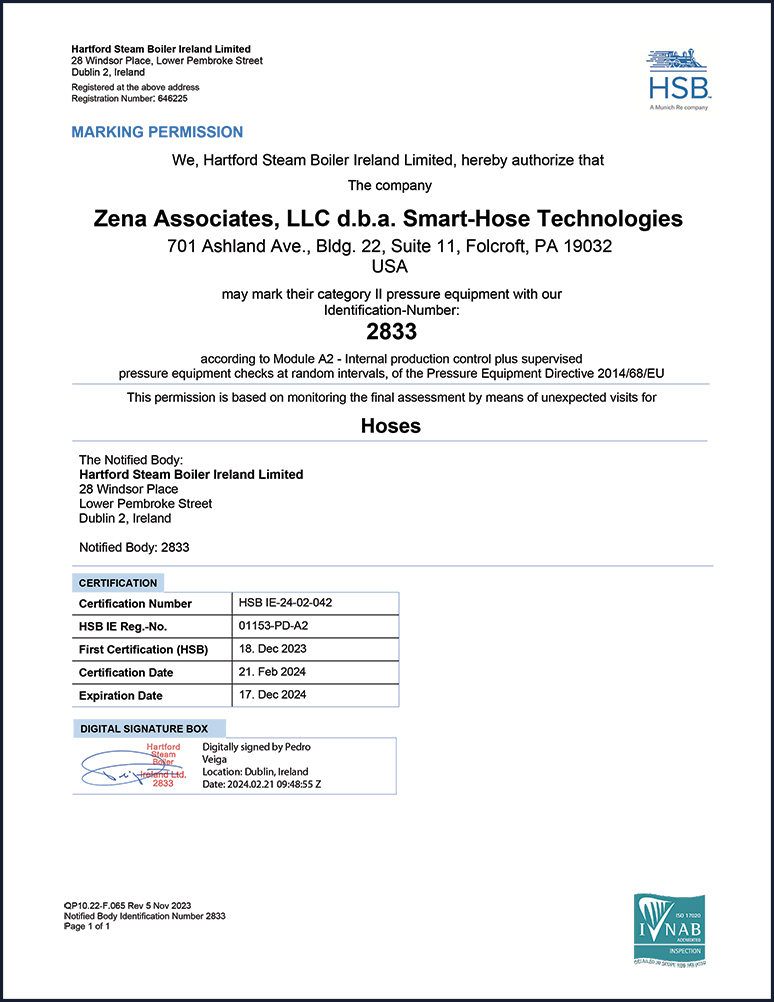
Smart-Hose Technologies safety hose assemblies are constructed under, and are in compliance with, the standards of the European Pressure Equipment Directive (PED) 2014/68/EU, and display the CE marking. See certification below.
CE Marking Permission
Smart-Hose® Technologies was granted the CE Marking Permission, first certification September 2015.
The CE Marking Permission authorizes Smart-Hose® Technologies to CE Mark Category II pressure equipment/hose assemblies in accordance with the PED (Pressure Equipment Directive.)
The CE Marking Permission allows Smart-Hose® Technologies to sell the Smart-Hose® Safety System throughout Europe for general chemical transfer applications that fall within the pressure and size ratings as defined by the PED.
The Technical Standards and Safety Authority (TSSA) is a not-for-profit organization that the Government of Ontario has mandated to administer technical safety regulations and provide safety oversight of various consumer and industrial product categories, including boilers, pressure vessels and piping. This Safety System concept was developed within the National Public Safety Advisory Committee (NPSAC), a counseling body consisting of regulatory agencies across Canada.
A Canadian Registration Number (CRN) is a unique identification number given to pressure equipment designs in Canada, issued by the TSSA. It is granted by each province or territory in Canada through an authorized safety authority for any boiler, pressure vessel or fitting that operates at a pressure greater than 15 psig (1 barg). The CRN identifies the design has been accepted and registered for use in that province or territory. All Canadian provinces and territories use the CRN system.
Below is a CRN listing for Smart-Hose Technologies products.
Canadian Registration Number (CRN)
Canada’s Technical Standards & Safety Authority has issued Smart-Hose® Technologies Canadian Registration Numbers (CRN) for the following (all) Provinces and Territories as listed:
Alberta CRN 0D16092.5C
Quebec CRN 0D16092.5C
Ontario CRN 0D16092.5
Saskatchewan CRN 0D16092.5C
Manitoba CRN 0D16092.5C
Prince Edward Island CRN 0D16092.5C
Nova Scotia CRN 0D16092.5C
New Brunswick CRN 0D16092.5C
Newfoundland CRN 0D16092.5C
Yukon CRN 0D16092.5C
Northwest Territory CRN 0D16092.5C
Nunavut CRN 0D16092.5C
Canadian Standards Association (CSA)
-for LPG Assemblies
The Canadian Standards Association (CSA) is a not-for-profit membership-based association. It is a standards development organization that develops and maintains consensus standards to help protect the health and safety of Canadians, enhance their quality of life, protect the environment, and facilitate trade. CSA is composed of representatives from industry, government, and consumer groups. It is accredited by the Standards Council of Canada (SCC), which promotes voluntary standardization in Canada, and, the American National Standards Institute (ANSI). CSA develops and maintains business excellence standards and guidelines for quality, environment, workplace health & safety, and risk management systems. It is a recognized leader in advancing worker safety and well-being in various areas. The technical and management standards developed with CSA’s more than 10,000 members improve safety, health, the environment, and economic efficiency in Canada and beyond.
The Smart-Hose Safety System meets the standards of, and is approved by, the CSA for LPG application usage (notation A.) To maintain certification, Smart-Hose Technologies must meet the requirements of audits conducted quarterly (per year) in addition to a comprehensive audit every five (5) years. A certificate is issued with all Smart-Hose Technologies products shipped to Canadian facilities, verifying our compliance with CSA regulations.
CSA International issued CSA approval (2017) for Smart-Hose® Technologies Type 1 LPG Smart-Hose assemblies.
Inspecta has issued Approval no. 12-454065-00 to Smart-Hose® Technologies. This is a Swedish Approval for the Penflex Series 700 1″ and 2″ metal hose assemblies, with flange connection.
CompanyApprovals
PRAXAIR
(and affiliates)
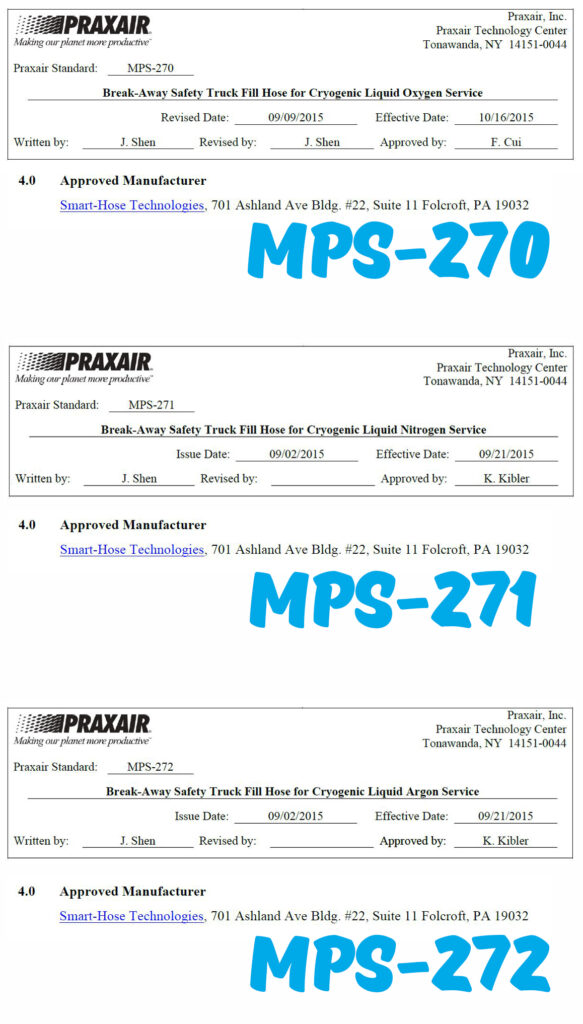
Smart-Hose® Technologies is a Praxair-approved manufacturer of 2-inch and 3-inch hose assemblies for:
MPS-270 Liquid Oxygen
MPS-271 Liquid Nitrogen
MPS-272 Liquid Argon
For Praxair European facilities (and affiliates):
Smart-Hose Technologies safety hose assemblies are constructed under, and are in compliance with, the standards of the European Pressure Equipment Directive (PED) 2014/68/EU.