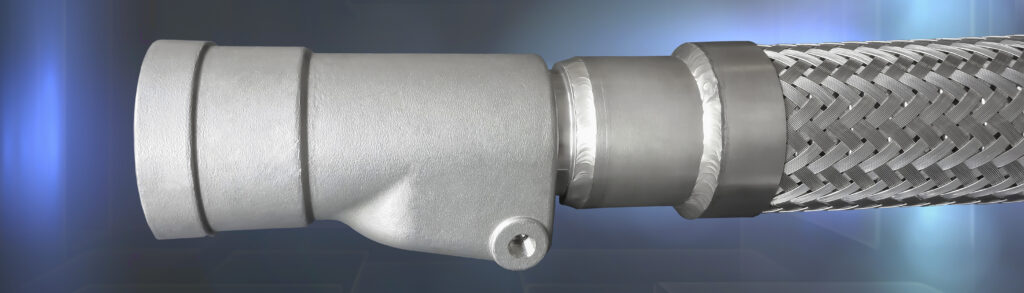
Safety metal hose assemblies are engineered components designed to maintain coolant containment and system stability within modern data center liquid‑cooling architectures. As rack densities increase and thermal loads rise, cooling circuits operate under continuous mechanical and thermal stress. These conditions introduce fatigue mechanisms that traditional elastomeric or composite hoses are not designed to withstand over long service intervals.
Metal hose assemblies provide high‑temperature resilience, pressure stability, and mechanical fatigue resistance required for permanent installation in liquid cooling loops. Their corrugated stainless‑steel construction accommodates thermal expansion, vibration, and dynamic loading without the creep, softening, or micro‑cracking observed in polymer‑based hoses. When paired with an integrated safety shutoff mechanism, these assemblies function not only as fluid conduits but as engineered safety devices that actively prevent uncontrolled coolant release.
System Integration and Lifecycle Reliability
Safety metal hose assemblies are designed for permanent installation within liquid cooling circuits — not temporary transfer operations. Their mechanical properties and integrated safety features support long service intervals and predictable performance.
Engineering benefits include:
Built‑In System Compatibility Assemblies can be specified for direct‑to‑chip cooling, manifold distribution, CDU connections, and rear‑door heat exchanger loops.
Reduced Technician Exposure Automatic isolation minimizes coolant release during maintenance, reducing slip hazards, contamination risk, and exposure to chilled or chemically treated fluids.
Lifecycle Reliability The combination of stainless‑steel construction and passive safety mechanisms provides stable performance across years of continuous operation.
Failure Dynamics in High Density Cooling Environments
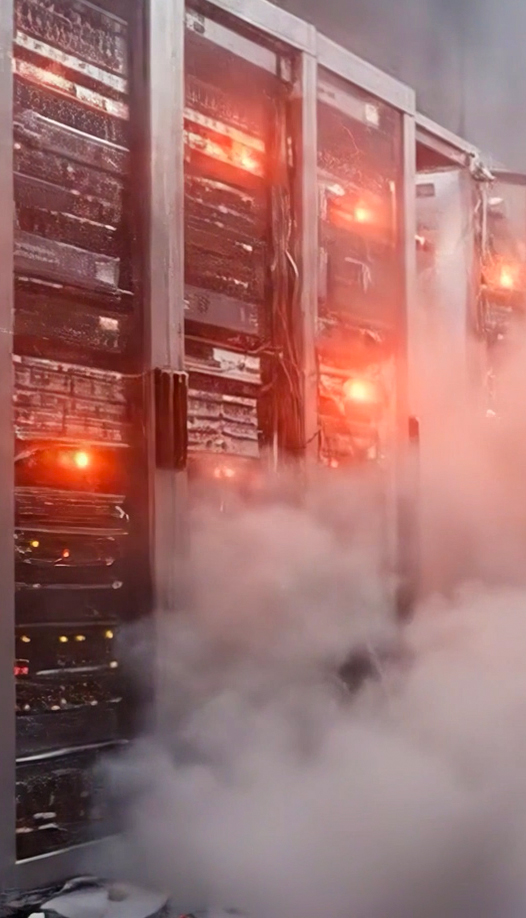
In a high‑density server environment, coolant lines operate continuously and often near the upper limits of allowable temperature and pressure. Under these conditions, even a small breach — such as a pinhole leak, braid separation, or end‑connection failure — can initiate a chain of events:
Localized thermal rise at the affected rack
Rapid loss of coolant pressure within the loop
Automatic server throttling or shutdown due to thermal excursions
Potential coolant contamination of electronic components
Propagation of thermal instability across adjacent racks
Facility‑wide downtime if the cooling loop cannot be isolated quickly
Traditional hoses rely entirely on external detection systems (pressure sensors, flow meters, leak detection pads) and human intervention. Safety metal hose assemblies incorporate a passive mechanical isolation mechanism that activates instantly at the point of failure, preventing the initial breach from escalating into a system‑level event.
Role of Integrated Safety Mechanisms
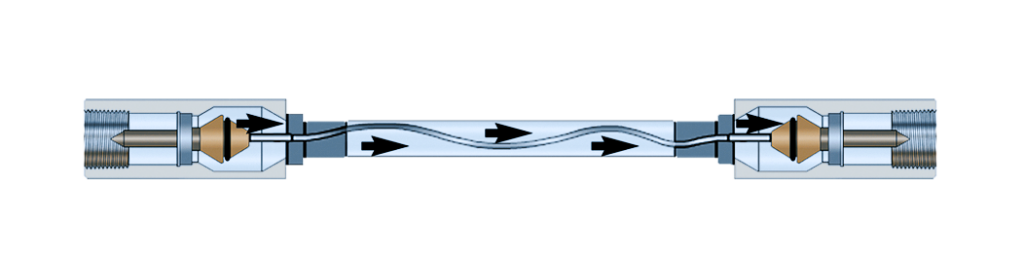
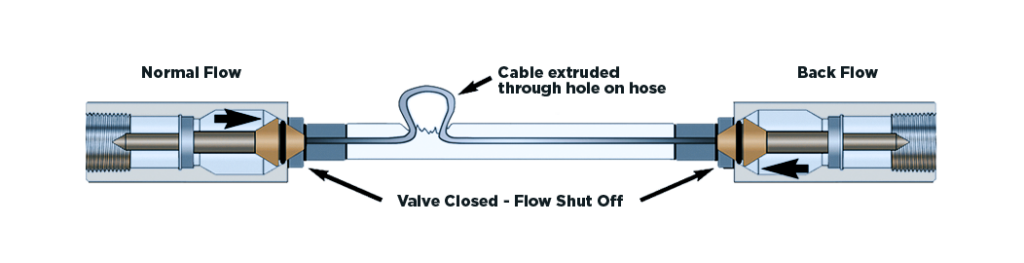
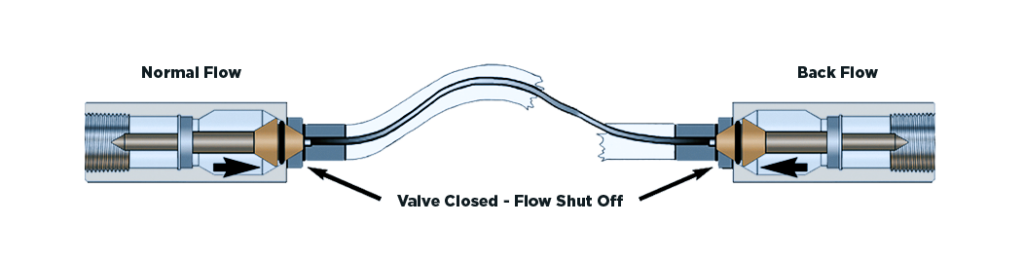
Smart‑Hose Safety Systems incorporate an internal valve mechanism that remains fully open during normal operation. If axial tension, separation, or rupture occurs, the valve automatically seats and isolates flow. This behavior is purely mechanical — no electronics, firmware, or external power — making it inherently reliable in environments where uptime is critical and failure response must be instantaneous.
Key engineering advantages include:
Automatic Flow Isolation The valve closes at the moment mechanical separation occurs, minimizing coolant discharge and stabilizing system pressure.
Passive Mechanical Protection The safety function is embedded within the hose assembly itself. No sensors, wiring, or supervisory controls are required.
Predictable Activation Behavior The shutoff mechanism is designed around known mechanical thresholds, ensuring repeatable performance across the product lifecycle.
Normal Flow
软管破裂
软管断裂
Mechanical and Thermal Performance Characteristics
Safety metal hose assemblies are engineered to withstand the operational stresses typical of data center cooling systems:
Thermal Cycling Resistance Corrugated stainless‑steel hose bodies accommodate expansion and contraction without fatigue cracking.
Vibration and Dynamic Loading Stability The hose structure and braid reinforcement maintain integrity under pump‑induced vibration, rack movement, and facility mechanical noise.
Pressure Containment Assemblies are rated for continuous duty at pressures common to direct‑to‑chip and rear‑door heat exchanger loops.
Material Compatibility Stainless‑steel wetted surfaces are compatible with common coolant chemistries, including water‑glycol blends and dielectric fluids.
Why Built‑In Protection Matters
Even with disciplined installation practices, routine inspection, and trained technicians, mechanical systems can fail. When they do, the difference between a minor service event and a facility‑wide outage often comes down to how quickly the system isolates the failure.
Safety metal hose assemblies provide a first‑line mechanical safety barrier that activates instantly, protecting equipment, preserving coolant, and maintaining operational continuity.
In environments where uptime is the business model, engineered safety is not optional — it is foundational.
Product Number(s):
+++-XXX-**-XXXX-X-XX-XX
Hose Options +++
M20 (single braid) – Penflex P4 Series
M21 (double braid) – Penflex P4 Series
Hose ID: 1”, 1-¼”, 1-½”, 2”, 3”, 4”
M03 (single braid) – Penflex Series 700
Hose ID: ¼”, ½”, ¾”
M04 (double braid) – Penflex Series 700
Hose ID: ¼”, ½”, ¾”
M11 (single braid) – Penflex Series 800
Hose ID: ¼”, ½”, ¾”, 1”, 1-¼”, 1-½”, 2”
M12 (double braid) – Penflex Series 800
Hose ID: ¼”, ½”, ¾”, 1”, 1-¼”, 1-½”, 2”
M14 (double braid) – Penflex Series 900
Hose ID: ¼”, ½”, ¾”, 1”, 1-¼”, 1-½”, 2”
M37 (double braid) – Hosemaster Pressuremax
Hose ID: ¼”, ½”, ¾”, 1”
** Fitting Options LL3 Hose ID: 1”, 2”, 3”, 4”
32 MNPT x MNPT
33 FNPT x FNPT
34 FNPT x MNPT
Note: Other hose material available upon certification.